

Is Subscription Coffee Actually Fresher?
Table of Contents
- What Makes Subscription Coffee Different
- Understanding Coffee Roast Date vs Best By Date
- The Science of Degassing and Flavor Development
- How Long After Roasting Should You Drink Coffee
- How to Store Coffee Beans for Maximum Freshness
- Subscription Coffee vs. Grocery Store Coffee: A Real Comparison
- Is the Cost Worth the Freshness Guarantee?
- Conclusion
Last Updated: August 17, 2026
What Makes Subscription Coffee Different
Subscription coffee operates on a fundamentally different supply chain than grocery store coffee. When you order from The Holy Grounds Coffee Co, your beans are roasted to order after you place your order, then shipped directly to your door with minimal delay. Grocery store coffee, by contrast, has already been roasted, packaged, and stored in distribution centers for weeks or months before reaching the shelf.
The freshness advantage is measurable. Roasted coffee beans begin degrading immediately as they release carbon dioxide and lose aromatic compounds. A subscription model compresses the journey from roasting to brewing into days rather than months. However, freshness isn't automatic just because something claims to be "roasted to order." The real question is whether the roaster prioritizes speed in their operations or simply uses the label as marketing while maintaining warehouse inventory.
Understanding Coffee Roast Date vs Best By Date
The roast date is when the beans were actually roasted. The best by date is a manufacturer's estimate of when quality will decline. These are not the same thing.
A roast date tells you exactly when roasting happened. The moment beans are roasted, they begin releasing carbon dioxide and losing volatile aromatic compounds that define flavor. The closer the roast date to when you brew, the more compounds remain.
A best by date is typically set 6-12 months after roasting as a conservative estimate. A bag with a best by date ten months away might already be three months old and past its peak. The best by date hides the actual age of the product.
When evaluating subscription coffee, ignore the best by date entirely. Focus on how recently the beans were roasted relative to your brew date. Coffee roasted within 3-7 days of brewing delivers the full flavor profile. Coffee roasted more than 2-3 weeks before brewing has already lost substantial character.
The Science of Degassing and Flavor Development
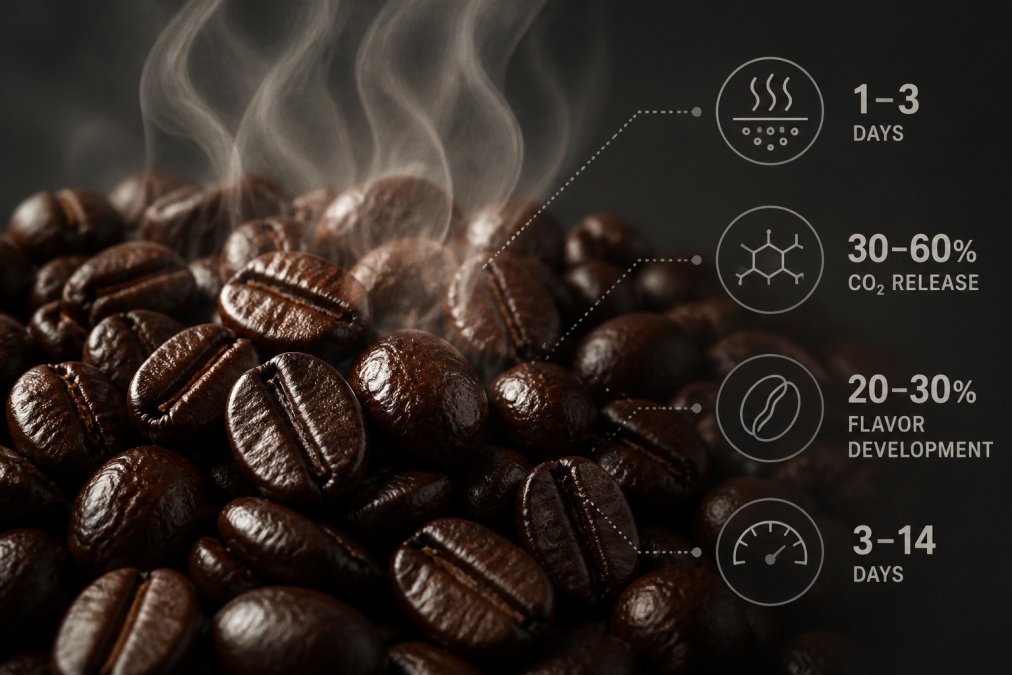
After roasting, coffee beans release carbon dioxide through a process called degassing. This is where understanding freshness becomes counterintuitive: "too fresh" coffee is actually a real phenomenon.
When beans are roasted, heat creates hundreds of volatile compounds responsible for aroma and flavor. These compounds are unstable and escape immediately. For the first 24-48 hours, degassing is intense. Coffee roasted less than 12-24 hours ago often tastes sour and lacks body because the degassing process interferes with water's ability to extract soluble compounds that create sweetness and texture.
Flavor development happens as degassing slows. Between 3-7 days after roasting, the degassing rate has decreased enough that water can properly extract the coffee's soluble solids. The aromatic compounds have stabilized. This is the optimal window for brewing.
After 3-4 weeks, oxidation accelerates. The beans have released most of their CO2 and are now losing the aromatic compounds that survived degassing. The coffee becomes flat and stale.
Subscription coffee from The Holy Grounds Coffee Co arrives in this optimal 3-7 day window, which is why it tastes noticeably better than grocery store alternatives. You're getting beans at the exact moment their flavor is most developed and their aromatic compounds are most stable.
How Long After Roasting Should You Drink Coffee
The ideal brewing window is 3-7 days after roasting. This is when the beans have completed most of their initial degassing, flavor has fully developed, and aromatic compounds are still stable.
Coffee roasted less than 24 hours ago will taste noticeably worse because degassing is still interfering with extraction. The beans need time to stabilize.
Most grocery store coffee is already 2-4 weeks old by the time you buy it. A subscription service that roasts to order and ships within 1-2 days means your beans arrive at day 2-3 of their life. You have the full 3-7 day optimal window ahead of you.
After 30 days, coffee is noticeably stale. The aromatic compounds have oxidized significantly. The cup tastes flat and dull.
The practical implication: brew subscription coffee within 2 weeks of receiving it. Assume grocery store coffee is already 2-3 weeks old and brew it immediately. The subscription model gives you time; the commodity model doesn't.
How to Store Coffee Beans for Maximum Freshness
Storage conditions dramatically affect how quickly coffee degrades after roasting. Coffee's enemies are heat, light, moisture, and oxygen.
Container matters. Coffee should be stored in an airtight, opaque container. A ceramic or stainless steel canister with a tight seal is ideal. Avoid clear glass, which allows light to degrade the beans, and paper bags, which are porous.
Temperature stability is critical. Store coffee at room temperature, ideally between 60-75°F. Don't refrigerate or freeze unless storing for months, as cold temperatures can cause condensation that accelerates staling.
Keep coffee away from strong odors. Coffee absorbs aromatic compounds from its environment and will transfer them to your cup.
Grind immediately before brewing. Ground coffee stales in hours, not days. Whole beans protect the interior from oxidation.
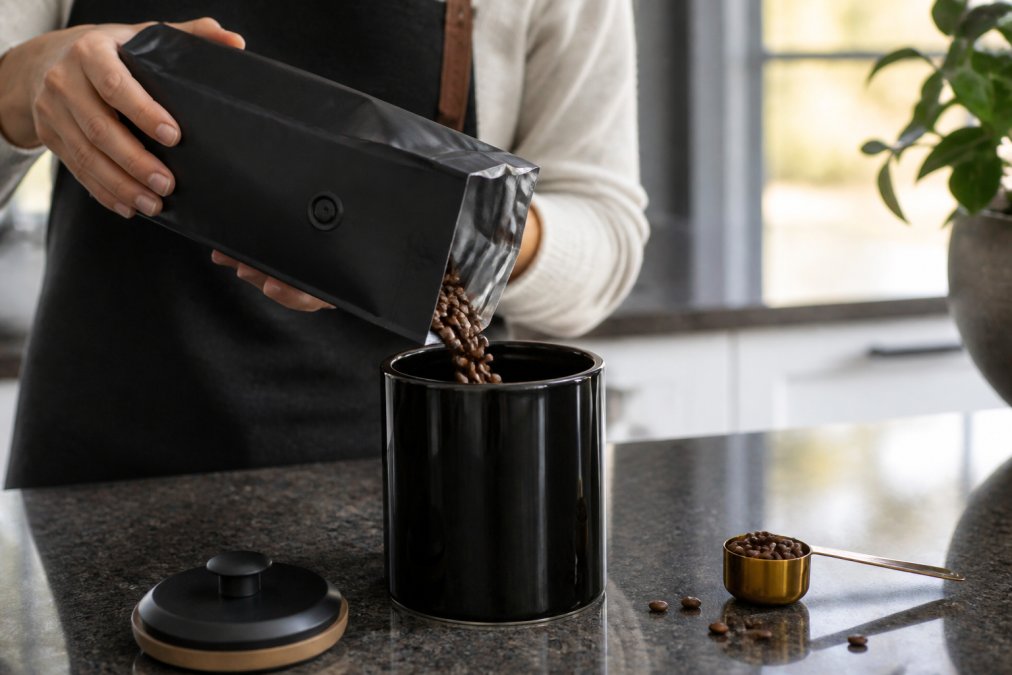
The subscription model gives you an advantage here. Because your beans arrive fresh, you don't need to buy large quantities and store them for months. You can order smaller amounts more frequently, ensuring you're always brewing from beans in their optimal window.
Subscription Coffee vs. Grocery Store Coffee: A Real Comparison
The freshness difference between subscription and grocery store coffee is measurable and significant.
Grocery store coffee follows this path: beans are roasted, packaged, shipped to distribution centers, placed on shelves, and purchased by consumers. Each step takes days. By the time you buy a bag, it's typically 3-6 weeks post-roast. The roaster builds in buffer time for shipping delays and shelf time, roasting in large batches and storing inventory in warehouses.
Subscription coffee from The Holy Grounds Coffee Co follows a different path: you place an order, beans are roasted within 1-2 days, the package ships, and it arrives 2-4 days later. You receive beans that are 3-7 days old. The entire process is 1-2 weeks, compared to 3-6 weeks for grocery store coffee.
The flavor difference is dramatic. Grocery store coffee tastes flat and dull because aromatic compounds have already oxidized. Subscription coffee tastes bright and complex because those compounds are still stable. The acidity is balanced rather than sharp. The body is full rather than thin.
Cost comparison: Grocery store coffee typically costs $8-14 per pound. The Holy Grounds Coffee Co subscriptions run $18-25 per shipment. That's roughly double the grocery store price. The question is whether the freshness justifies the cost.
For most coffee drinkers, the answer is yes. The flavor difference is substantial enough that you drink less coffee and enjoy it more. A smaller cup of fresh, complex coffee is more satisfying than a larger cup of flat, stale coffee.
| Factor | Subscription Coffee | Grocery Store Coffee |
|---|---|---|
| Typical roast age at purchase | 3-7 days | 3-6 weeks |
| Roast-to-delivery time | 3-5 days | 21-42 days |
| Flavor profile | Bright, complex, balanced | Flat, dull, oxidized |
| Typical price per pound | $18-25 | $8-14 |
| Storage time before staling | 2-3 weeks | 1-2 weeks |
Is the Cost Worth the Freshness Guarantee?
The price premium is real. A subscription service costs roughly 2-3 times what you'd spend on grocery store coffee. The answer depends on how much you value coffee quality and how much coffee you actually drink.
Here's the practical math: a bag of grocery store coffee costs $10 and makes roughly 30 cups (33 cents per cup). A subscription bag from The Holy Grounds Coffee Co costs $23.99 and makes roughly 30 cups (80 cents per cup). You're paying an extra 47 cents per cup for fresher, better-tasting coffee.
The hidden cost of grocery store coffee is the coffee shop visits. If you're drinking stale home coffee, you're more likely to stop at a café for a decent cup. A $5 latte twice a week is $40 per month. A subscription service at $100 per month for 4 bags might actually save you money compared to supplementing bad home coffee with café purchases.
The freshness guarantee itself has value. When you order from The Holy Grounds Coffee Co, you know your beans are roasted to order and shipped immediately. You're not gambling on whether the bag is fresh or wondering how long it's been in storage.
Conclusion
Subscription coffee is genuinely fresher than grocery store coffee. The roast dates are younger, the supply chain is shorter, and the beans arrive during their optimal flavor window. This is a structural advantage of the subscription model.
The freshness difference translates directly to flavor. Coffee roasted 5 days ago tastes noticeably better than coffee roasted 5 weeks ago. The aromatic compounds are more stable. The body is fuller. The acidity is balanced.
The cost premium is real, but it's not as steep as it initially appears when you factor in reduced café visits and the satisfaction of a better daily ritual. For coffee enthusiasts and remote professionals who drink coffee daily, The Holy Grounds Coffee Co delivers the freshness guarantee with carefully sourced, single-origin beans roasted to order and shipped directly to your door. Find Your Perfect Roast and experience the difference that genuine freshness makes in your cup.
Frequently Asked Questions
How long does coffee stay fresh after roasting?
Coffee reaches peak freshness 5-14 days after roasting, depending on roast level and brewing method. Light roasts peak earlier; dark roasts have a slightly longer window. After 30 days, oxidation and flavor degradation accelerate noticeably. Proper storage in a vacuum-sealed bag with a one-way valve extends this window by slowing carbon dioxide loss and oxygen exposure. Most specialty roasters recommend consuming within 2-4 weeks of the roast date for optimal flavor.
What's the difference between roast date and best by date on coffee bags?
The roast date tells you exactly when the beans were roasted, which is the true measure of freshness. Best by dates are often vague and may be set 6-12 months out for liability reasons, not actual flavor quality. Subscription coffee services emphasize roast date because it's precise and meaningful. When you see a roast date, you can calculate the exact brewing window and know the beans are fresh. Grocery store bags often hide or omit roast dates, making it impossible to assess true freshness.
How should I store coffee beans to keep them fresh longer?
Store beans in an airtight, opaque container away from heat, light, and moisture. A vacuum-sealed bag with a one-way valve is ideal because it allows carbon dioxide to escape without letting oxygen in. Keep beans at room temperature, not in the freezer or refrigerator, as temperature fluctuations cause condensation and flavor loss. Avoid storing near windows, ovens, or direct sunlight. Whole beans last longer than ground coffee because grinding dramatically increases surface area exposed to oxygen, accelerating oxidation and staling.
Is subscription coffee worth the extra cost compared to grocery store options?
Yes, if freshness and flavor matter to you. Subscription services roast to order and ship within days, ensuring beans arrive at peak freshness with a clear roast date. Grocery store coffee often sits in warehouses for months before reaching shelves, then sits longer on the shelf. You'll taste the difference in aroma, acidity, and flavor profile. For coffee enthusiasts, the quality jump justifies the cost. For casual drinkers, grocery store coffee may suffice. The real question is whether you value the sensory experience enough to invest in it regularly.
Ready to upgrade your daily coffee? The Holy Grounds Coffee Co roasts your beans to order, ensuring maximum flavor and aroma in every cup. With single-origin options like the Whiskey Barrel Aged ($23.99) and fast, reliable delivery, you'll taste the difference freshness makes. Start your subscription today and join coffee drinkers who've made the switch from grocery store staleness to roaster-direct freshness.
This article was written using GrandRanker